Saturday, August 15, 2015

Imperfect Peaches

This year, the peach harvest is a bit patchy, as our trees have been beset by many insects, including Japanese beetles.


Despite this, we have had a number of peaches ripen.

Peaches and pears gathered today
When the peaches are marred by unsightly pock marks, I wash them and cut them into small edible slices.


Two large peaches can make enough dessert for three.


The slices are then distributed among three glass cups ...


        ... and topped with whipped cream.


We all enjoyed our peaches and cream today.


Nobody complained about the fruit's imperfections.


Thursday, April 23, 2015

Will It Taste Just As Good Without the Parchment Paper?

Some of the Ingredients for the Best Homemade Brownie Recipe

If you have a child in high school choir, you will find yourself occasionally drafted into a baking project. Every time there is a concert, your child will need to not only be able to sing well, she will also need to be properly attired and bring a home-baked item for the bake sale. There are no exceptions.

Last time I baked brownies from this recipe:

http://www.thevintagemixer.com/2013/02/best-homemade-brownie-recipe/

Things turned out very well, so I was asked to bake the same brownies this time. The only problem: I can't seem to find any more parchment paper. I looked all over WalMart last night, both in the section with baking mixes and flour and baking soda, and in the other part of the store where they sell baking pans and other cooking paraphernalia. Last time, I already had parchment paper in my kitchen drawer from some other long forgotten project. But now I have none, and I am wondering how much that matters. After all, it's not an actual ingredient of the brownies. You're not supposed to eat it!


Last time the big hold up was the high fat butter. I could not find it anywhere, so I ended up using regular Land O'Lakes sweet butter.  The Land O'Lakes butter has 11 grams of fat in each tablespoom. All the calories in butter come from fat, because that's what butter is: milk fat. However, not all butter you buy in the store is the same.


This time, I have two other kinds of butter to choose from: Clearly Organic and KerryGold. Like the Land O'Lakes butter, Clearly Organic also contains 11 grams per tablespoon. But KerryGold, imported from Ireland, is slightly different.


Kerrygold contains 12 grams per tablespoon.


Now the real question for me is: what else does the butter contain besides fat?  Because there are 14 grams in every tablespoon and only 12 of those grams come from fat. The answer, I think, has to be water, because water has no caloric value, and all the calories in the butter come from fat. But if you look at where the ingredients are listed on the package of Kerrygold, the only ingredient listed is "cultured, pasteurized cream." They don't list the culture, the way some yogurts do, and they do not break the cream down into its chemical ingredients, which would probably be something like milk fat and water. And then, for the sake of people who don't know what cream is, we are told explicitly "contains milk."


On the very back of the Kerrygold package, it says; "In Ireland, cows graze on the pastures of small family farms. This milk is churned to make Kerrygold butter." So presumably, the extra water in the butter over and above the fat is water found naturally in the cow's milk.

This makes me reflect on whether the American butter also only contains water from the milk of cows, or whether their butter has been watered down in other ways. For instance, what on earth do they mean when they say: "Ingredients: sweet cream, natural flavoring" ? Did they put something in the cream to flavor it? If not, why did they need to say that?

Sometimes people from the FDA object to certain foods because they contain "too many calories" or "too much fat." But keep in mind, the primary reason for eating food is for the calories, and one type of calorie humans cannot live without is fat. You can choose to eat more or less of any food. But if you paid for 14 grams worth of food, wouldn't it be good to get as many calories per gram as possible, simply from an economic standpoint? Shipping water all the way from Ireland seems silly. Even shipping it from the neighboring state is not economical. You can use more or less butter in your recipe. But the consumer never gets any benefit from the producer watering down the product. Products rich in nutrients cost more because they are worth more per gram.  And all those labels screaming "Low fat!" or "Low Calorie!" on the grocery store aisle might as well be saying: "Less food for your money!"

I am planning to use the Kerrygold butter to bake the brownies this afternoon. I am hoping that the absence of parchment paper from my list of ingredients will not in any way affect the flavor or the nutritional value of the brownies, although it might have a slight impact on the presentation.


Sunday, March 22, 2015

The Problem with Labels

The other day, when I was shopping as quickly as I could -- I pay dearly for every hour I am away from Bow, so I try to make good use of the time -- I picked up a bag of what I thought was shredded cheese at a good price, and I made a mental note of how I planned to use it. Variety in snacks is highly prized at my house, so I remembered that I had some tortillas at home and was getting some spaghetti sauce and some pepperoni, and I decided I could use all these ingredients together to make a quick pizza-like snack. No, it would not be as good as real pizza, but I thought the cheese, freshly melted, would give it some real value. It would be a standby that week, instead of the usual tagini and burritos.

Executing my plan at home.  I brushed some oil onto the tortillas, spread spaghetti sauce on top of that, then the shredded cheese, and for those who like pepperoni, added that on top. My oven was set to 400 degrees. I left the tortillas there for over ten minutes and checked to see if the cheese had melted. It hadn't. I left them there for another ten minutes. The cheese had still not melted.

The whole point of this was to get a quick snack. "Something must be wrong with my oven," I thought. So I took one of the tortillas and heated it up in the microwave for five minutes. The cheese still did not melt! Could both my oven and the microwave have gone on the fritz at the same time? I had made a roast the night before and there had been no problem. 

We ate the snack, but it wasn't very good and certain among us did not finish it. 

Then later I took a really good look at the label. It was not cheese. 


It was, instead "Fancy Shredded Monterey Jack Style Shreds." Now how do you parse that? Was it shredded shreds? Shreds of what? Shreds of Style?


When I was in  a hurry, if I read anything, it was probably this part "Fancy Shredded Monterey Jack" and I assumed it was cheese. Never assume!

But as a linguist, now that I see what it really says, I still wonder how to parse that:


       Is it   [[Fancy [shredded [Monterey Jack]] [Style Shreds]], meaning it is style shreds of Monterey Jack which happens to be fancy and shredded? So basically shreds of style?

        Is it   [Fancy [shredded [[Monterey Jack] Style] Shreds]], meaning that it is shreds in the style of Monterey Jack which have been shredded and these shredded shreds are fancy? In which case, it does not say shreds of what, but whatever it is, it's in the style of Monterey Jack and in addition it is shredded and fancy?

 There are a few other ways it could be parsed, but I leave you to work them out. The fact is that the top label was very confusing even when I read it carefully, and it was only after I had read the ingredients that I came to the sad conclusion there was no cheese in this product.There was some whey and some lactic acid, so there were dairy products in there, but it was probably not cheese, because the fat in this product was not derived from cream or milk. The main ingredient besides water and starch was soybean oil. 

But this is confusing, and in order to make sure it is really not cheese, one would actually need to know what cheese is. Many of us are a little fuzzy on the concept, so one way to find out would be to compare the ingredients here to those in a product that is basically cheese.


Above is a picture of a Monterey Jack cheese label. Notice the word cheese is used, but it's still kind of confusing, as the "sliced Golden Natural Cheese" seems to modify the words Monterey Jack. The ingredients seem simpler than those of the shreds: Pasteurized milk, kosher enzyme, culture, salt, natural coloring. But is this real Monterey Jack? What is the coloring and the emphasis on it being golden?

Here below is a link to a recipe for how to make Monterey Jack:


I looked at the recipe, not because I am planning to make Monterey Jack myself, but because I wanted to know what is normally found in that cheese. This recipe calls for cream.  Is the Moneterey Jack it describes more "real" or "authentic" than the one in the package above?

Most consumers, myself included, don't think about the ingredients of cheese when they are looking for cheese. Cheese is an indivisible whole, a basic concept in food. We just want the label to tell us whether it is cheese or not. And that's exactly what the label will not say. It is being coy.

Yes, I know it is important to read all the ingredients. It took me several years of chewing aspartame-laced gum to find out that even though I was carefully buying the kind that had sugar in it, they had slipped aspartame into all the normal gum products of the main brands, not just those which were marked sugar-free.

And recently I heard that they changed the name of aspartame to aminosweet in 2009.  High fructose corn syrup, also much maligned, almost changed its name to "corn sugar"

I don't think that the real solution to food substitutions -- soy for milk-fat, high fructose corn syrup  for cane sugar or molasses, GMO for natural produce and the like -- can be resolved by labeling, because labels are hard to read and can be very misleading. If you lobby the Federal agencies in charge of labeling, you can end up with a new name for the same product every few years. I would not trust the government to keep our food pure or even to help us find out what is in it. 

I think the best way to find out what is in a food is to talk to the person who made it. Which is why I favor a free market that allows consumers to buy directly from the farmer, the local dairy or the baker. It's better to buy food from the people who grew it and made it, if you do not have the time to grow or make it yourself. The real issue is trust. I think a real person would tell you if the cheese he made was real or fake, He would not try to push it on you as fancy shredded shreds of nothing in particular.

Monday, January 19, 2015

Eggs Baked in Muffin Cups

I got the idea for baking eggs in a muffin pan from something I saw on the internet. My contribution was to also use a paper muffin cup and to separate out the whites and the yolks.

The larger ones are blueberry muffins, and in the center there is one whole egg, and another egg divided into yolk and white.

I was planning to bake blueberry muffins anyway, in the larger muffin pan, so I decided to use the smaller pan for the eggs.

The Full Egg

The muffins were done much sooner than the eggs, despite being larger. I allowed the eggs to overcook a little, because I did not want any part to remain raw.


The Egg Yolk
The separated eggs were a little overdone, as they were smaller than the whole eggs.

The Egg White
My daughter likes the whole egg. I am allergic to the egg white, which consists mostly of protein, but I can eat the egg yolk, which also contains fat. Nobody in our house likes egg white in particular, but if you know someone who is afraid of adding fat into the diet, the egg white is something they might like. I remember that on the show Gilmore Girls, the comical character of Michel, who was constantly watching his diet and who went with the latest fads, was often seen asking for an egg white omelet. If you have someone like that in your life, you can give the egg white to him. In our house, we give them to the dogs, who will eat anything. That way, nothing goes to waste.


The eggs separate easily from the muffin cups, and there is no mess to clean, in the pan or on the plate. You can even eat them without a plate or utensils in the great outdoors, because these are eggs that will not run!


Monday, October 20, 2014

Pine Branch Tea for Clear Breathing

When I was very little, I was given to attacks of asthma, usually brought about by allergic reactions to pollen. It began when I was three and continued until my teen years. At one point I was on allergy medication, but it made my heart race, so I stopped taking it. Instead, I resolved on a policy of trigger avoidance. I was allergic to cats, grass and dust. I decided to avoid these things at all costs. Humid environments were bad for me, so I used air conditioning all the time, even when it was not that hot outside, just to dry the air I breathed. In this way, I avoided having to deal with my asthma, without having to take any medication for it.


Recently, the asthma came back. I was about to set out on a trip and did not have time to see a doctor. So I consulted my friend Marie Lasater who is a registered nurse and an expert on natural remedies. She recommended pine branch tea for what ailed me.


Here are Marie's instructions: "Break off a small twig from the end of a branch with needles on it. Put the whole branch, about 4 or 5 inches long in a pot of water and bring to boiling. Let boil one minute, then cover pot and let it steep about 10 min. Pour into a cup, and add any sweetener you like."

I drank the tea and my symptoms were relieved. I used brown sugar as a sweetener the first time, but after the first cup I realized that it was mild enough to drink unsweetened. And it did relieve my symptoms, but only temporarily. This is not a cure. It is just a palliative.

How does it work?

Here are some authoritative links that Marie provided me with:

http://www.ncbi.nlm.nih.gov/pubmed/24120901

and

http://www.ncbi.nlm.nih.gov/pubmed/24555293

As near as I can make out, the compounds in the tea reduce inflammation and cut down on secretions caused by inflammation. What they do not do is actually force bronchial passages open, the way the ephedrine in the Primatene tablets I used on my trip do.

This is a good home remedy to take if you have plenty of time and are at home. On a trip, it is less helpful, though you could brew a batch in advance and carry it in a thermos.

Friday, September 19, 2014

The Perfect Cheesecake

by Marie Lasater, Guest Blogger

I’ve been in search of the perfect cheesecake for years – that rare cheesecake that cannot be found at The Cheesecake Factory, and certainly not at the local grocery store, AKASara Lee.” The perfect cheesecake is a little dry to the palate, not creamy, and you can taste the cheese!

At the ripe old age of 57, after trying dozens of recipes that pretty much produced a flat cake that tasted like eggs, I found IT, the perfect cheesecake. And I stole it. The recipe, that is. And now I am going to share it with you.

My gorgeous friend Theo had an intimate little gathering at her place. The purpose was three-fold: Christmas, the launch of her new book, and running her new boyfriend through the gauntlet. On the table laden with a succulent smoked turkey and canapés and hors d’oeuvres of every description was an open spot. The spot was soon filled when Theo took the most beautiful cheesecake I have ever seen out of her oven. I was speechless. The cake was a work of art, spilling over the sides of its spring-form pan, with a light brown crust and those noteworthy cracks on top of which only a “real” cheesecake can boast.


As I took my first bite, not only could I taste the cheese, my palate was exhilarated with the dry, yet crumbly feel of what I consider a true New York style cheesecake. I announced, “Theo, I must have this recipe!” She handed me a small piece of cardboard from a box with some instructions written on it. This Holy Grail proclaimed in Theo’s handwriting “this one.”

I grabbed that piece of cardboard, and as soon as I could, I took off to my own kitchen. Anxious to see if I could create the masterpiece, I followed the sketchy directions on that piece of cardboard.

Perfect Cheesecake

1 lb. cream cheese
24 oz. ricotta cheese
16 oz sour cream
1 1/2 cup sugar
1/2 cup butter -softened
3 tbs. flour
Make a graham cracker crust with graham cracker crumbs and melted butter, and press into the bottom of a spring-form pan. Bake the crust for 10 minutes at 375 degrees.
Beat all the above ingredients, then add 4 lightly beaten eggs (I use farm eggs), 2 Tbs. lemon juice and 1 Tbs. vanilla. Pour into the spring form pan and bake at 375 degrees for 75 minutes.


This cheesecake is delicious plain, but if you are taking it to an event, I bring home-made preserves (peach, blackberry) and let folks add their own topping.

Sunday, July 27, 2014

Asian Rice and Pork Dish with Fried Zucchini and Blackberry Lemonade

I am not much of a cook. But lately I've been making these Asian style dishes with rice and pork. They are very easy to make, so I thought I would share them here.


First we make the rice. I usually boil two cups of water and one cup of rice, adding about half  a stick of butter to the water and a little seasoned salt with turmeric for flavor. When the water is boiling, I also throw in one egg yolk. If you have ever looked at how rice is prepared for Asian dishes, you may have noticed that rice isn't all that's going into the pot. The secret to making nutritious rice  dishes is adding a lot of fat to the carbs. After bringing the water to a boil. I lower the heat so the rice can simmer. It takes about fifteen minutes for most of the water to be absorbed into the rice.


Now for the pork part. I use either butter or lard to grease a skillet and I cut the pork into little pieces. In this case, I also had a nice, fresh zucchini from the garden of my friend Kathy, so I fried the zucchini first, then I added the pork.After things get very hot in the pan, I add some teriyaki sauce.


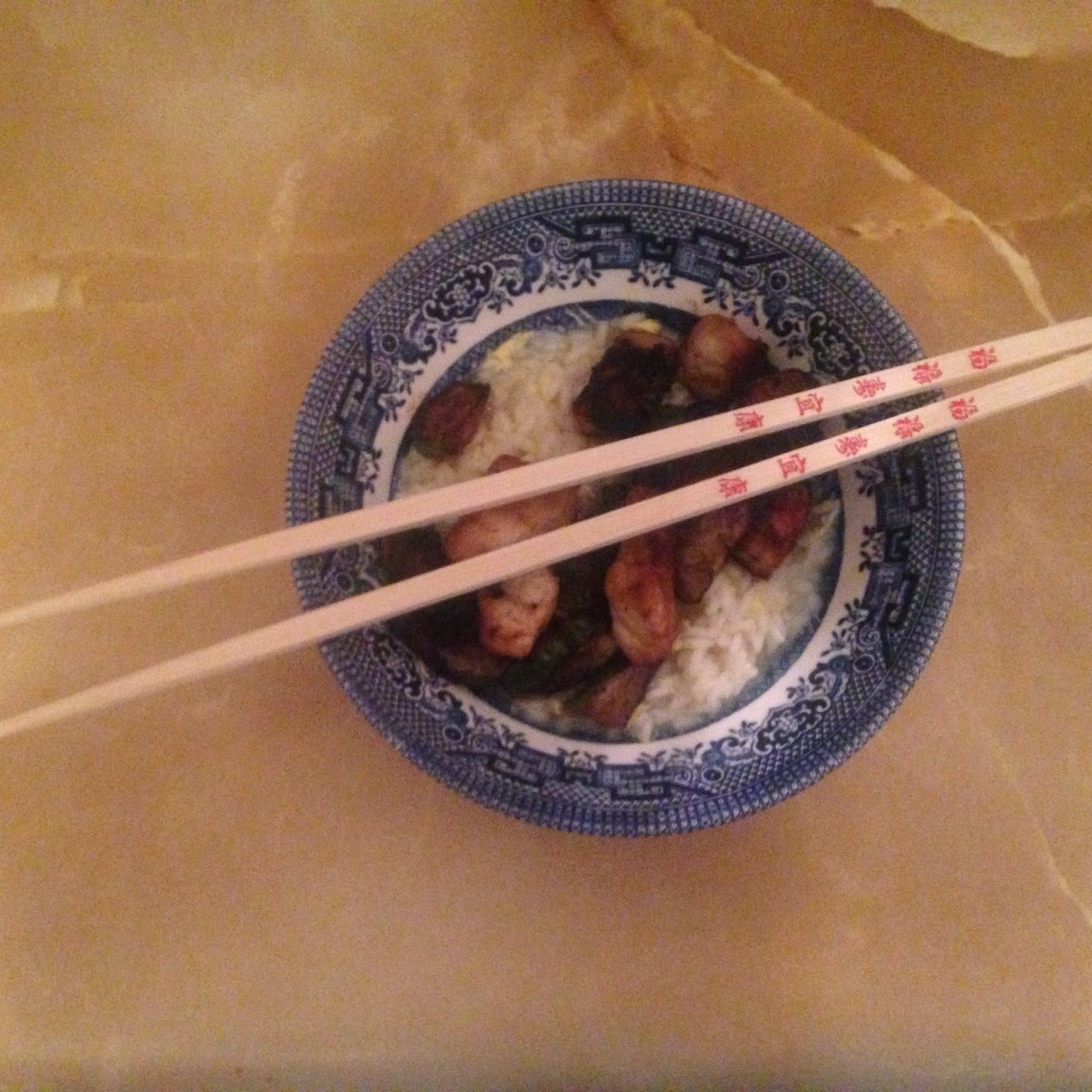
Once the rice was ready, I put it into the bowls first, then added the pork and fried zucchini.


Sometimes adding chop sticks makes the dish look more authentic.


But not everybody likes to use chopsticks, so providing a spoon is also a good idea.


Blackberries for dessert are nice.


Blackberries are in season here now, so picking a bunch is not a problem.


But if you don't have a very big harvest, you can just put a few blackberries into each person's lemonade for a special treat.