Thursday, February 13, 2014

Orange Peel

By Marie Lasater, Guest Blogger

In the category of never throwing away nutritious foods, orange peel ranks at the top. There are dozens of uses for orange peel, and it provides benefits that can’t be found elsewhere.

Peels can be prepared with or without added sugar.

With generous amounts of Vitamin A and calcium, 1 Tbs. of orange peel also provides 14% of your vitamin C requirement and 3% of a daily dose of dietary fiber, with only 6 calories. In addition, it offers potassium, phosphorus, magnesium and some zinc as well.

Orange peel contains natural pectin, useful in making jams and jellies, and also decreases the rise in blood sugar after a meal.
Nutritional benefits aside, orange peel also contains large amounts of limonene and hesperidin, components that have huge health benefits.

Limonene

The major component in oil extracted from the orange peel, limonene has exceptional tissue healing properties. It is a potent antioxidant with anti-inflammatory effects, and in addition to its anti-cancer properties, it is effective for many other metabolic and health problems – even helping with weight management.

Anyone who has used orange oil as a cleaning agent is aware of its degreasing properties. In the body it serves as a unique fat cleanser, helping to clear cholesterol sludge, including the sludge in the gall bladder that can form stones. Limonene helps reduce appetite and improve metabolism, making it one more nutrient to assist with healthy weight management. And of great importance, it is a superior nutrient for breast cancer prevention.
Hesperidin
Hesperidin has been studied for about 50 years. The highest concentration of hesperidin can be found in the white parts (pith) of the orange peel. Flavonoids such as hesperidin have been identified as the anti-diabetic components in a number of traditional remedies.

Hesperidin has a strong impact on blood cells and is used to help treat varicose veins. In Europe, this natural ingredient is used to make Diosmin, a prescription medication for treating venous insufficiency.

Hesperidin is also used to reduce hay fever and other allergic conditions by inhibiting the release of histamine from mast cells.

Orange peels can be prepared in several ways: processing them to make candied peel, drying them and grinding them to an orange zest, or finely grinding them to a powder.

My family loves candied orange peels!

The final product


Here is the simple recipe:

Candied Orange Peel

· 2 large oranges, 1/8 inch of top and bottom cut off
· 1 1/2 cups sugar, divided
· 2 cups water

Cut peel on each orange into 4 vertical segments. Remove each segment (including white pith) in 1 piece. Cut into 1/4-inch-wide strips. If you squeeze your own orange juice, just cut strips from the peels after extracting the juice. Cook in large pot of boiling water 15 minutes; drain, rinse, and drain again.

Bring 1 1/2 cups sugar and 2 cups water to boil in saucepan over medium heat, stirring to
dissolve sugar. Add peel. Return to boil. Reduce heat; simmer until peel is very soft, about 45 min. Drain.

Toss peel and 1/4 cup sugar on a plate, separating strips. (You can also skip this step to lower the sugar content.)Transfer peels to sheet of foil. Let stand until coating is dry, about 24 hours. The peels will transform after about a day into a delicious, melt-in-your-mouth treat.


Peels curing for 24 hours.


Note: Save any remaining liquid after removing the peels, and you will have a delicious orange
syrup for pancakes, stir-fried dishes, etc.The original water that you first boiled the peels in can be saved for use in cleaning products, or as an additive to homemade facial tonic. I make homemade laundry detergent, and I have found that adding one cup of my “orange water” greatly boosts the cleansing power.


Orange zest in coffee grinder


Dried orange peels can be ground in your coffee grinder to make a fabulous orange zest. Add it to stir-fry dishes or to cornmeal for breading fish prior to frying for enhanced flavor and nutrition. Grind an extra minute or two for a fine orange powder. Lime and lemon peels can also be processed with your oranges.


Limes and lemons together with oranges

Sunday, February 9, 2014

Super Foods Are Poverty Foods

by Sena Brothers ,  Guest Blogger

These are listed as “super foods”: oats, eggs, potatoes, cabbage, tuna, beans, rice, bananas, olive oil, lemons, tomatoes.

They add fiber, nutrients, vitamins, minerals, antioxidants, protein, and essential fats as well as being cheap.

Except for the potatoes and eggs, they can be purchased in a readily edible state – beans, tomatoes, and tuna come canned; bananas, cabbage, lemons, and tomatoes can be eaten raw; oats (old fashioned rolled oats, not instant oats!) and rice simply require hot water to pour over (and then cover and let soak for 10 [oats] - 40 minutes [rice]). Eggs and potatoes do require some cooking, which means access to a heat source and a container in which to cook them.

This means that these "super foods" are accessible and affordable for the poor and/or homeless.

It's not the best diet, but it's certainly a diet that will keep you alive and relatively healthy.

I think it needs the addition of a sweetener – honey, cane sugar, and a few herbs and spices to make it palatable:  cinnamon, salt, pepper, onions, garlic, parsley, and some greens like turnip or mustard or spinach.

I keep tuna, canned beans, rice, and oats at work and in my car as emergency foods in case of getting iced in. I also have rice noodles (they only need hot water poured over them, like the oats and rice, to be edible). If I have access to hot water (boiling temp hot), I can eat well, if somewhat boringly, for very little money.

Sometimes, you have to get a little creative with these, and there are equally inexpensive alternatives:  canned chicken costs almost the same now as canned tuna, so they can be alternated for variety. While bananas are good, apples are equally as good. Lemons can be traded for oranges or grapefruit. Sometimes, other seasonal fruits and vegetables can be cheap. I like keeping celery and carrots on hand because they add flavor, color and more nutrition to change things up.

A complete super foods/poverty foods shopping list would then look like this:

  • Old fashioned rolled oats
  • Eggs
  • Potatoes
  • Cabbage
  • Tuna (or canned chicken or ham)
  • Beans (red kidneys, pintos, turtle or black beans, black eyed peas, split peas...)
  • Rice (long grain jasmati, texmati, basmati are tastiest and still inexpensive)
  • Bananas, apples, seasonal fruit
  • Olive oil, butter, canola oil
  • Lemons, oranges, limes, grapefruit
  • Tomatoes
  • Greens (mustard, turnip, spinach, bok choy...)
  • Salt
  • Pepper
  • Parsley
  • Garlic (fresh or spice jar)
  • Onions (fresh or spice jar)
  • Cinnamon
  • Optional:  a brick of cheddar cheese.


There are tricks to make these foods palatable when this is all you have to eat. One trick I like using is toasting the oats. Toasted, they can be used as a crisp topping, like croutons on a salad or a soup, or to add depth of flavor to other dishes, and as a “breading” for tuna patties. The oats can be toasted in a dry skillet over medium heat or on a baking sheet in the oven at 425 degrees F. It takes 3 – 8 minutes to get them toasty brown, and they need to be stirred often to prevent scorching.

Potatoes can also be used like croutons for salads and soups.  Simply dice the potatoes into small pieces, brown them in the oven or a skillet over medium heat with a little bit of olive oil until they are crispy and richly brown.

The oats can be cooked very simply and practically fool proof by adding a pinch of salt and pouring boiling water over them - ½ cup of oats and ¾ cup boiling water, covering it and waiting about 5 minutes.  You can use less or more water, depending on how thick you want the oats to be.  Once the water is absorbed, mash half a banana in to sweeten it, and maybe a ¼ teaspoon of cinnamon – cheap, healthy, tasty, and fast, with no dirty pans to wash – you can make this right in the serving bowl.


A simple “cookie” can be made of the cooked oats mashed with banana and seasoned with a bit of cinnamon – simply drop the cooked oats by the teaspoonful onto a lightly oiled baking sheet, flatten slightly, and bake at 375 degrees F for 8 – 10 minutes, until browned and crisp on the edges. They'll still be slightly chewy.

Or, instead of using cooked oats, use 1 cup toasted oats, mash with one banana, ¼ teaspoon cinnamon, a pinch of salt.  Mix until crumbly and spread out in crumbles across a lightly oiled baking sheet.  Bake at 425 degrees F for 8 – 10 minutes, until dried and crispy and browned.  Let cool, and you have a simple crumb topping to eat as is for a snack, or to sprinkle onto hot applesauce or fried apples, or scatter over a tomato soup or a salad.

Using just the toasted oats (no banana!), you can mix in a can of tuna and an egg to make tuna patties.  One can of tuna, mixed with ½ cup toasted oats and 1 whole egg will give you 6 patties.  Fry them in a lightly oiled hot skillet, and serve with rice and greens for a super food, delicious, and cheap meal. You can also mix the tuna with cooked rice to make patties – or mix rice and canned chicken for chicken patties.  The patties can also be used as a filling for sandwiches.

Rice can be cooked the traditional way, but I find I have really good results cooking rice the same way I do oats – pour boiling water over the rice with a pinch of salt, cover and let it sit for about 20 minutes or until the water is absorbed.  For ½ cup of raw rice, use about 1 to 1 ¼ cups boiling water. The rice doesn't burn, doesn't develop that crisp bottom layer (which I adore, as it makes for a lovely bowl of Singing Rice Soup...), and usually comes out fluffy and soft.

Cooked rice forms the foundation of many meals, and can then be stir fried with greens, carrots, onions, garlic, and a drained can of chicken for a meal suitable for 4 people – densely nutritious, filled with fiber, and cheap.

Beans are equally as versatile. They can be cooked tender, drained, and mashed to make bean sammies:  spread on bread, top with some optional shredded cheese, run under a broiler just long enough to melt the cheese, or with diced tomatoes and spinach, and you have a super nutritious, cheap meal.


Beans can be added to nearly anything – they make great spreads, soups, dips, “meatloafs” and desserts. Chili is a great favorite with beans – they can stretch a pound of ground turkey or beef from 4 servings to 8 or even 10 servings without sacrificing flavor or nutrition.


Potatoes have entire cookbooks devoted to them. My favorite is to shred a potato, mix in an egg and some salt, pepper, and ground celery seed, then fry it in a bit of butter and top it with cold applesauce. Potato soup, chowders, mashed potatoes, baked potatoes, there are so many ways to eat potatoes.


A filling breakfast is to shred a couple of potatoes, press them into a lightly oiled 6 portion muffin pan, tear or chiffonade some spinach and press that on, then crack an egg into each one, sprinkle on some chili powder, salt, pepper, and put it in the oven at 350 degrees F for 3 minutes or until the egg is set to your preference.  Sprinkle on some diced tomato and cheese to serve.

And one last recipe:

Mayonnaise

1 egg yolk
juice of half a lemon
1 cup cooking oil (olive, corn, canola, safflower...)

Reserve the egg white for another recipe. Whisk the yolk and add 1 or 2 drops of lemon juice.  Continue whisking.  Add a drop of oil and whisk some more.  Now, while whisking madly, slowly add the oil a few drops at a time.  As the mixture begins to come together, add the oil in a slow trickle.  Keep whisking! Whisk until all the oil has been added. It should now look like mayonnaise. Whisk in a few drops of lemon juice to brighten it up. This is enough mayonnaise for a potato or egg or tuna salad or a couple of sandwiches.  It will keep in the refrigerator 2 or 3 days. It takes about 10 – 15 minutes of mad whisking to make this and it's so cheap!

It's good to know that being homeless or poor doesn't mean eating badly or starving.


Thursday, January 23, 2014

What to Do with Raw Milk

I have been eating a fairly low carb diet for the past twelve years, ever since I moved to Missouri to start Project Bow, and it has kept me healthy. I am not overweight, I am seldom sick, and most of the time I feel fine. But... things could be better. And that's why I am looking into raw milk.

I enjoy eating many different kinds of foods, including meat, fruits and vegetables, nuts, cheeses, yogurts and even cakes and sweets. When I was little, I could eat anything, and just about everything agreed with me. As I grew older, fewer and fewer things agreed with me. I had to start to restrict my diet, just so I could have a good day.

The first thing that had to go was liver. I can't eat that, anymore, although I used to enjoy liver with fried onions. Later, I pretty much eliminated Coca-Cola and other sugary carbonated drinks. I still can have an occasional Coke when I eat out. But the only reason I can afford to do that is because I hardly ever eat out.

I learned that bread was not good for me, and neither was cake. Eliminating store bought bread in the United States was not hard for me, because it does not even taste like bread. If I were in Israel it would be more of a problem. But I do occasionally bake cakes, because I have a human daughter and a chimpanzee son, and there's no reason they should be entirely deprived, just because I can't enjoy cake without taking a punishment.

When I bake a cake, I try a piece, too. And sometimes I can get away with that. And sometimes I can't, and I feel very bad the next day. So I repent of my evil sin of indulgence, and I swear to do better in the future. But complete abstinence is hard, and I personally don't believe that that is the best answer to every "substance abuse" problem.

I accept the low carb credo, and I abide by it, more or less. I understand that highly processed foods, like sugar and flour and other carbs play a real number on our system and can result in spikes in our blood glucose that can lead to weight gain, insulin resistance and diabetes. I also understand that sugar feeds parasitic yeast cultures in our body, and especially those in our GI tract. So staying away from carbs is a good idea for anyone who has these problems.

It's just that .... wouldn't it be great to be somebody who doesn't have problems? Wouldn't it be wonderful to have a body that knows how to eliminate excess blood sugar and excess bacteria in the gut without depriving the person who inhabits it of the joys of normal carbohydrate intake? I still am a big fan of eating more fat than carbs. I just don't want to feel that I can't have an occasional carbohydrate treat if I want one.

I have also read that having the wrong bacteria in the gut can cause mental issues, including anxiety, depression and autism. One way to fight bad bacteria in the gut is to take antibiotics designed to kill them. I have anecdotal evidence that this really works. One time I had the flu and antibiotics were prescribed to me. One side effect was that my gut felt as good as new for about a week! I thought I was cured. But, of course, living on antibiotics is a very bad idea. What else can we do? We could repopulate the gut with good bacteria. The good bacteria would then help to drive the bad ones out -- or at least keep them in check.

 I am going to try to repopulate my gut with the right kind of bacteria. One way to do that is to take probiotics, but it would mean trusting a drug company to process the cultures correctly, and I am not that trusting. Another way is to drink raw milk and to make milk by-products that are chock full of good bacteria.


What does raw milk taste like? It's a lot like store bought milk, only richer and creamier. It is good for you, higher in fat, and therefore lower in carbs, and with a hint of the taste of mother's milk. But if you want the real benefits of raw milk, try it after it has gone sour! Store bought milk has to be thrown out the moment it goes bad, but raw milk keeps getting better and better!


I am still learning about the process of turning raw milk into other products chock full of good bacteria, so I will just include a few videos here by Sarah Day. She seems to know a lot about the topic! The first video is about separating milk and cream.


The next is about how to make cream cheese and  liquid whey.


And this one is about how to make sour cream!


Have you ever wondered about how to make buttermilk and butter? Sarah Day will show us how.


Of course, you can also just drink the plain milk raw, which is good, too.


Monday, January 20, 2014

Turkish Delight in the Heart of Everyday Winter


by Michelle PG Richardson, Guest Blogger


When I was young, winter always meant that “The Lion, the Witch, and the Wardrobe” (the movie of the book by C.S. Lewis), would be on television.  It was a special my sister and I never missed.   My mom would call the two of us into the den and get us both cozy on the couch.  Our TV was a big 70’s color console, and even though we wanted to sit on the floor closer to it, we weren’t allowed.  Eight to ten feet back was the rule.  Any closer was bad for our eyes.


My sister and I loved that movie.  It never got old.  It was the first place I’d ever heard of Turkish Delight, the enchanted candies that the White Witch enticed Edward with.  They symbolized the sins of the flesh: greed and gluttony; though neither of us understood, nor did we care to understand any of that at the time.   We did, however, understand that the crinkle of plastic, and the closing of the freezer door, followed by the rip of foil paper, meant that we were in for a special treat of our own: oven-warmed Twinkies.  Golden, creamy perfection.

Sweets were a rarity in my house growing up.  Usually it meant a spoon of honey with a piece of walnut.  In the summer it meant fruity popsicles, or vanilla ice cream with cut up strawberries.  At Christmas it meant Baklava.  At New Years it was Vaselopita (a dense spicy cake with a dime baked in – the one who got the dime in their slice would get good luck for the rest of the year).  


But in the heart of everyday winter, while The Lion, the Witch, and the Wardrobe played, we got what my sister and I considered the best treat of all, one oven-warmed Twinkie a piece. Though in truth not nearly the same sort of sweet at all, in theory, it was our very own enchanted Turkish Delight.  With cream filling oozing out of the three little holes down the middle.  We’d count each time.  Sometimes, if we were lucky, there would be a crack in the toasty cake that would also ooze cream filling that we could lick up before taking our first bite. We were very proud and savored them as we thought Edward should have savored his Delight.  In our opinion, he ate his much too fast.  We knew Edward’s desire for an endless supply of his favorite treat.  Though unlike Edward, we were content with what we had and would never think of turning on each other for more.  Not really.


I’d never given a second thought to real Turkish Delight.  They haven’t sold them anywhere I’ve been (though I hear that some fine restaurants in Chicago and New York offer them on their menu).  My mother said she’d had them as a child and that they were indeed very rich, and very good, and very small.  She grew up in Greece, so I assumed they were an exotic sweet and that perhaps one day, when I got to travel to exotic countries, I might chance upon a fine little shop’s counter display of Turkish Delight and fall in love.  I expected I would find them, or they would find me.  I never expected that I would be making them myself.

This past year I’ve been dabbling in quite a bit of dessert making, from melt in your mouth, paper thin, butter cookies to decadent chocolate brandy truffles, making up for lost time, I suppose.  I found I was rather good at making what most people considered difficult sweets.  But I had yet to try something where a candy thermometer was involved.  It was time to test my abilities.


The Lion the Witch and the Wardrobe had been strong on my mind.  It was, after all, that time of year again, a decades old ritual calling to me.  And for the first time, I thought long and hard about Turkish Delight.  I dreamed about them.  I studied recipes.  I became obsessed with the desire to offer my winter guests the food version of “the sins of the flesh”.  I wanted to make a creation, an offering, which would entice and mesmerize with every bite that crossed each set of lips.  I wanted to be the Queen of decadence.  And so I set out to do just that.


Michelle PG Richardson, Eye On Life Magazine

Tuesday, January 14, 2014

Salad with Cream Cheese from Sour Cream

I have been reading up on how natural cultures in dairy products might help to fend off mental issues. Meanwhile, in my own refrigerator, unbeknownst to me, a minor transformation was taking place with in my sour cream.


The sour cream was not past its expiration date. It did not smell or taste bad. But part of it had frozen in the back of the refrigerator, and it was dehydrated and seemed a lot more like cream cheese and a lot less like sour cream.

I decided to add cherry tomatoes and leftover brussels sprouts to the cheese and the tortilla. This is what I served Bow for lunch today.


Bow asked for the salad first. Because he started with the tortilla, he kind of forgot to use his spoon most of the time.


Bow liked his salad so much that he only ate an apple afterwards and did not want his banana or his soup.

I am going to have to research the culture they put in the sour cream after pasteurization. How is this culture different from the bacteria they kill during the process of heating? There is so much more I will need to learn before I understand what cultures we may currently be missing in our diet.

But Bow has no questions. It's all good, as far as he's concerned.

Wednesday, December 11, 2013

Slow Cooking, Fast Eating

During my first year in Taiwan, I had a slow cooker. Well, it wasn't really mine. A friend lent it to me, and I returned it to her at the end of the year. But it was a nice way to prepare food when there was not time to slave over a hot stove.

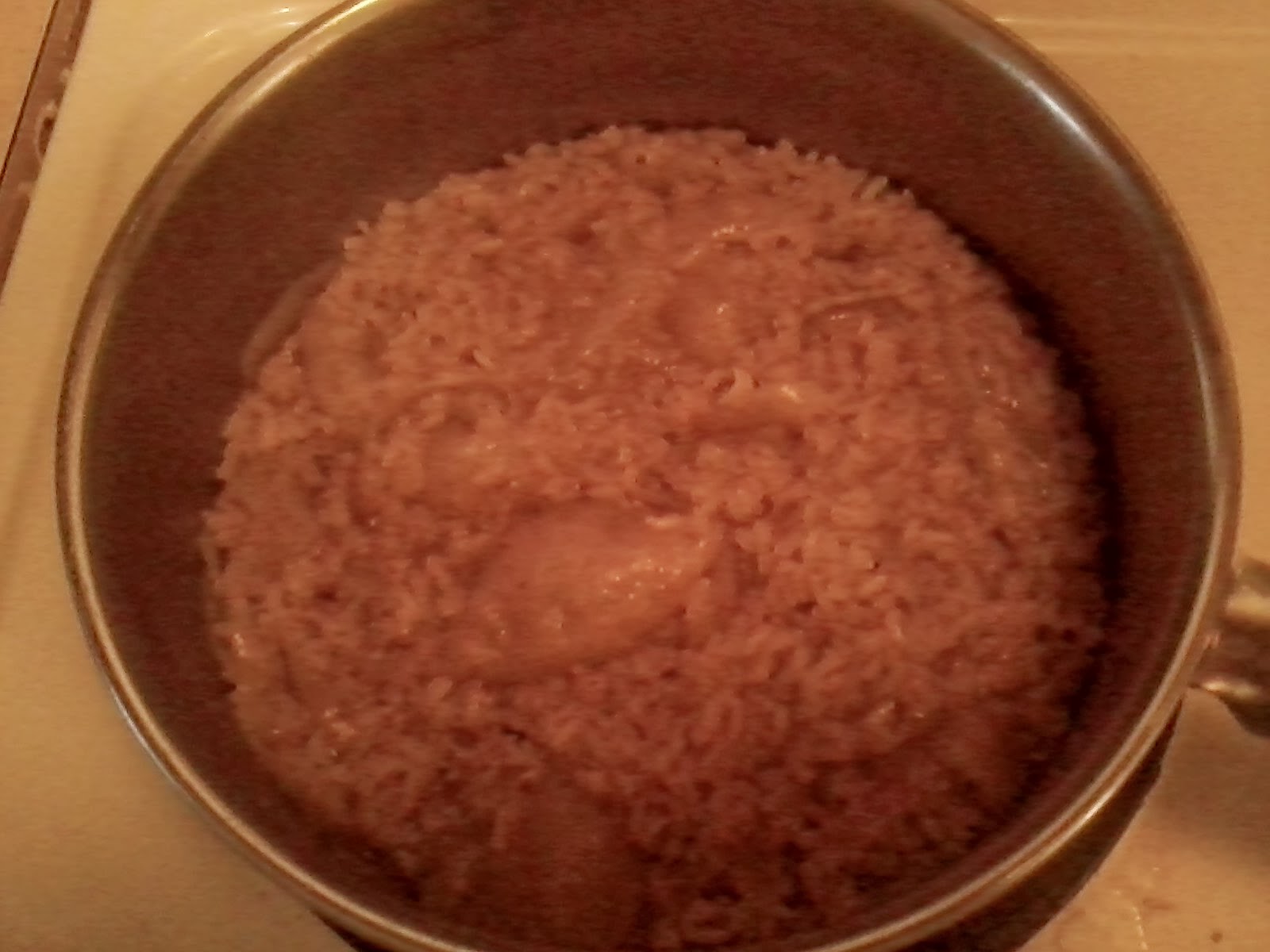
Here in Missouri, I don't have a slow cooker. But I have found that if you leave the burner on low, the food cooks more slowly. Last night, two hours before dinner, I threw into a pot some chicken stock I had left over, which also contained two baked onions, and about a cup of brown rice. I let the concoction boil, then cool down, and  I left that on the stove for over two hours on low. At the end of the two hours, the rice which had at first been almost invisible, came to dominate the pot.


It was our main course for dinner. Here is what Bow's dinner consisted of:


His rice bowl looked like this:


Bow asked for his red apple first, then the yellow one. After that he asked for the rice. I was not sure whether he would like it, but he seemed to relish this part of the meal and gave me back a clean bowl.


After that, he asked for his Kedem Biscuits. They are from Israel, and my mother brought them over for us in a bag of goodies during her Thanksgiving visit.


Bow eyed the handful of biscuits I gave him, trying to decide which deserved to be eaten first.


Of course, it really did not matter which one he started with. He finished them all.


After he had done with the biscuits, he asked for his turkey breast, and after that the "big" banana, followed by "more banana." By then the entire meal had been consumed.

Bow went to bed on a full belly and in a very good mood.


Friday, November 29, 2013

Cranberry Sauce and Sparkling Red Grape Juice

As always, we had an abundant feast yesterday at Thanksgiving, including a turkey, stuffing, cranberry sauce, sweet potatoes, pumpkin pie and sparkling red grape juice.


My mother was the chief cook and Sword assisted her. Bow made excited food calls as he saw everything carried into the pen, as always.


But though Bow asked for the stuffing first, his favorite food this year was the cranberry sauce.


 He treated it with all the reverence and solemnity of a truly spiritual feasting experience.


The other thing that Bow seemed to really enjoy was the red sparkling grape juice, which he savored with much ceremony.


It's the simple things that Bow is most thankful for. Especially if they are red, sweet, juicy and sparkle in the light!